Every major city has one. New York has SoHo and the Meatpacking District. London has Shoreditch. Milan has Brera. Miami has the Design District. These are the places where craft, architecture, art, and commerce converge, where the built environment is understood as an aesthetic statement rather than just a functional one, and where the concentration of creative talent produces something greater than any individual studio or showroom could achieve alone.
But what if the most extraordinary design district in the world isn’t a neighbourhood at all? What if it’s an entire island?
Bali’s credentials as a global design destination have been accumulating quietly for decades. The island is home to one of the world’s most sophisticated living craft traditions, woodcarving, stone masonry, textile weaving, metalwork, and ceramic arts practised at a level of skill that very few places on earth can match. And increasingly, that artisan tradition is finding its most compelling contemporary expression not in galleries or retail showrooms, but in the design and construction of private villas that have become genuine architectural statements in their own right.
A Craft Tradition That Never Industrialised
What makes Bali’s design district fundamentally different from its urban counterparts elsewhere is that the craft tradition here was never disrupted by industrialisation in the way it was in most of the developed world. The woodcarvers of Mas, the stone sculptors of Batubulan, the silver smiths of Celuk, the weavers of Tenganan, these aren’t artisan revival movements or heritage preservation projects. They are living, practising communities where skills have been transmitted across generations without interruption.
For anyone designing and building a private villa in Bali, this means access to a depth of craft capability that simply cannot be replicated in most other building contexts in the world. A set of hand-carved teak doors with intricate floral and figural detailing, the kind that would be museum-quality objects in most Western cities, can be commissioned directly from third-generation carvers who learned their craft from their fathers and grandfathers. A carved stone gateway featuring traditional Balinese iconography can be produced by stonemasons working in an unbroken tradition that predates any contemporary design movement by centuries.
This is what places Bali’s design ecosystem in an entirely different category from any curated design district that a city has consciously assembled. The creative infrastructure here wasn’t planned or developed, it emerged organically from a culture that has always understood craft as inseparable from spiritual and community life.
How Artisan Craft Translates Into Villa Architecture
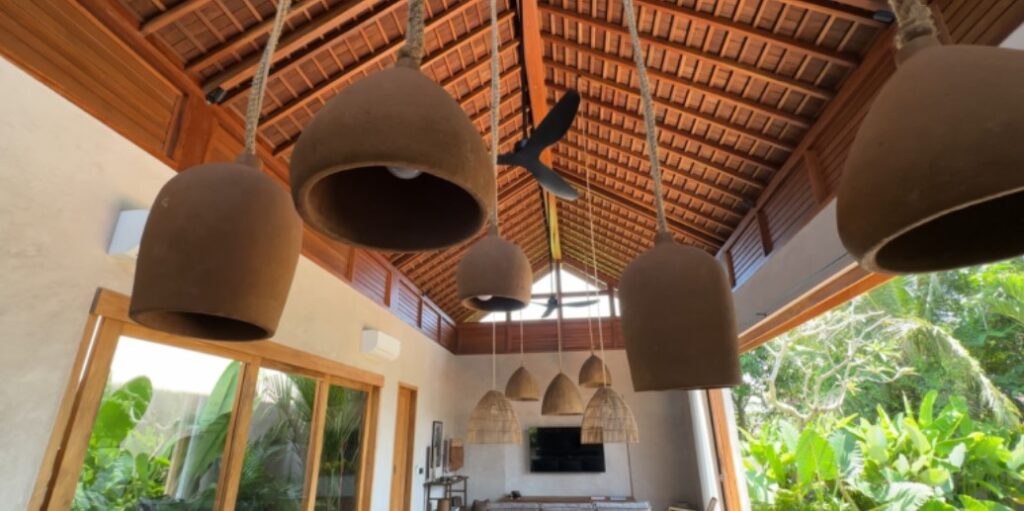
The most distinctive Bali villas are the ones where the island’s artisan tradition isn’t applied as decorative finishing, a carving here, a hand-woven textile there, but is integrated into the architectural logic of the building from the earliest design decisions.
Structural timber as sculptural element. In villas built with genuine design ambition, reclaimed teak columns and beams aren’t hidden behind cladding or paint. They’re expressed honestly, their grain and character allowed to define the atmosphere of a space. The carpenters who work with antique Javanese teak understand the material at a level that goes beyond technical skill into something closer to material intuition, knowing how a particular piece will move with humidity, how it will develop over years of use, which faces to orient for maximum visual impact.
Stone as landscape and architecture simultaneously. Paras limestone, Bali’s distinctive soft, warm-toned volcanic stone, is used throughout the island’s finest villas in ways that dissolve the boundary between building and landscape. Garden walls that become water features. Entry pathways where the stone has been shaped to direct water flow as well as foot traffic. Bathroom surfaces that connect the act of bathing to the material world of the island itself. These applications require stonemasons with deep knowledge of how paras behaves, how it weathers, how it takes carved detail, how it responds to the tropical climate across years and decades.
Textile and weaving integrated into spatial design. Balinese and broader Indonesian textile traditions, ikat, batik, songket, hand-loomed cotton in colours derived from natural dyes, offer a vocabulary of pattern and colour that connects an interior space to centuries of cultural meaning. In the hands of a thoughtful designer, these textiles aren’t simply decorative objects. They become the primary instrument through which a villa interior communicates its relationship to place.
The Design District Ecosystem: Who Makes It Work
Like any great design district, Bali’s creative ecosystem is more than the sum of its individual craftspeople. It’s a network, of suppliers, designers, architects, builders, and material specialists, that has developed over decades of collective practice.
The furniture showrooms concentrated around Seminyak and Canggu represent the commercial face of this ecosystem: curated collections that draw on Bali’s artisan capabilities while packaging them for an international market. But behind the showrooms lies a deeper infrastructure of workshops, suppliers, and fabricators where the real creative work happens, and where the most interesting design conversations take place between architects, interior designers, and the craftspeople who will actually build what the drawings describe.
For anyone commissioning a new villa, understanding this ecosystem is essential. The most impressive results come not from selecting pieces from showroom floors but from commissioning directly, engaging craftspeople at the workshop level, bringing them into the design conversation early, and allowing the capabilities and limitations of the craft tradition to genuinely inform the design rather than simply executing a fixed specification.
This is where the choice of construction partner becomes critically important. An experienced team of Bali villa construction experts who has established relationships throughout this artisan ecosystem, who knows which stone carver produces the finest detail work, which timber merchant sources the best reclaimed teak, which textile workshop can produce custom pieces to a specific design brief, brings something to a villa project that no amount of architectural ambition can substitute for on its own.
What the World’s Design Districts Can Learn From Bali
There’s a useful perspective shift available to anyone who approaches Bali through a design district lens rather than a travel one. The things that make great urban design districts compelling, the concentration of craft expertise, the density of creative relationships, the sense of a living tradition rather than a curated heritage, are all present in Bali in forms that most urban design districts are actively working to cultivate or reconstruct.
The difference is that in Bali, these qualities weren’t assembled by urban planners or economic development agencies. They emerged from a culture that never separated the practical from the aesthetic, the functional from the sacred. The same impulse that drives a Balinese family to commission elaborately carved temple gates for a ceremony also drives the regional design tradition that produces the world’s most characterful villa architecture.
For designers and homeowners who take this seriously, who approach a Bali villa not as a tropical escape decorated with local motifs, but as a genuine collaboration with one of the world’s great living craft traditions, the results are buildings that feel fundamentally different from anything that can be produced elsewhere.
They feel, in the deepest sense, like they belong to the place that made them. And that quality, of genuine rootedness, of a building that couldn’t exist anywhere else, is increasingly the rarest and most valuable thing that architecture can achieve.
Building Within the Tradition
For those ready to move from admiration to action, to commission a villa that genuinely engages with Bali’s design district ecosystem rather than simply borrowing its aesthetic, the starting point is a construction partner who understands the tradition from the inside.
This means more than technical construction capability. It means fluency in the design vocabulary of Balinese architecture, established relationships with the artisan community, and the project management experience to coordinate between architects, interior designers, and craftspeople working in multiple disciplines simultaneously.
The villas that best represent what Bali’s living design district can produce are rarely the ones built fastest or cheapest. They’re the ones where every material decision was made with knowledge of its cultural context, every craft element was commissioned from the right hands, and the construction process was managed by a professional villa building team in Bali with the depth of local expertise to make the whole thing cohere.
In a world where great design districts are increasingly rare and increasingly imitated, Bali remains genuinely itself. The villas that honour that fact are the ones worth building.
This article explores Bali’s artisan design tradition and its influence on contemporary villa architecture, as part of an ongoing series on the world’s most significant design communities.